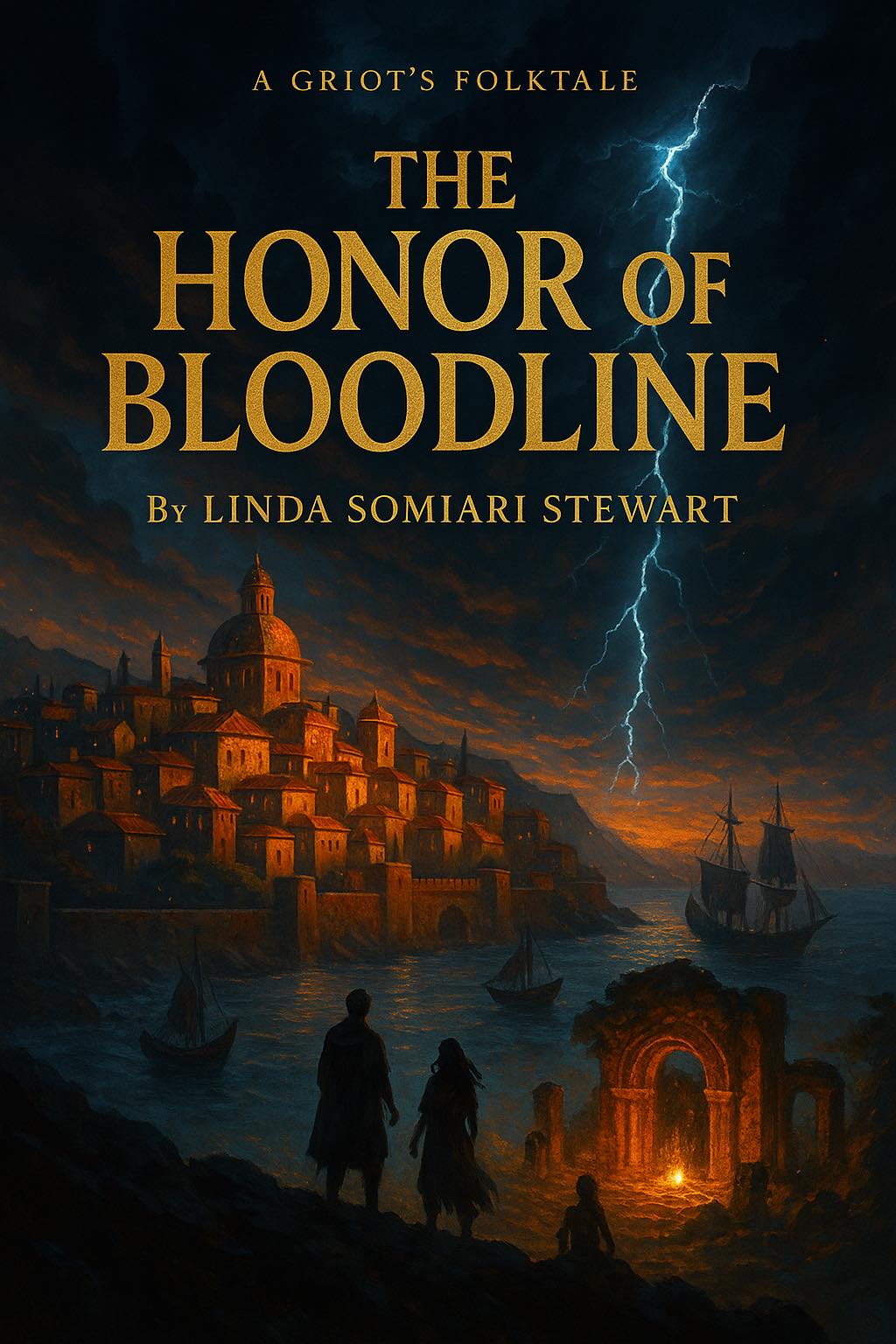
The Honor of Bloodline by Linda Somiari Stewart
Long ago, on the wind-kissed coast of the Great Motherland, there was a village called Kombé, nestled between the endless blue of the ocean and the whispering green of the forest. Kombé was known far and wide, not for riches or warriors, but for honor—a sacred thread that bound every soul to their ancestors.
Now, in Kombé, a child did not merely belong to a mother and father. No. A child belonged to a lineage—to the ancient ones whose bones rested beneath the baobab trees, whose names lived in every mouth, whose stories danced in the fire’s glow.
One day, a young man named Tandu, son of Bako the Weaver, grandson of Osei the Brave, was caught stealing fish from his neighbor’s drying rack. The act sent ripples through the village like a stone dropped in sacred water.
But in Kombé, thieves were not caged. They were not beaten. No. Tandu was brought to the Circle of Remembrance, at the heart of the village, where the elder griots waited with cowrie-laced staffs and eyes like weathered stone.
The oldest among them, Elder M'Zaya, stepped forward. His voice was like thunder rolling through molasses.
“Tandu, child of Bako, blood of Osei… do you know whose name you carry?”
Tandu bowed his head, ashamed. But Elder M’Zaya was not finished.
“Your grandfather, Osei, once crossed the great river with no boat, swimming against the current to save a child from drowning. He returned, not with riches, but with honor. Your father, Bako, wove cloth so fine it was said the wind wore it proudly. And now you… steal fish?”
The crowd was silent, not in anger, but in mourning—for the fracture in the bloodline.
Tandu trembled. “I—I was hungry, Elder.”
Elder M'Zaya nodded. “Hunger is no shame. But forgetting your name is. In this village, we bear not just burdens—but legacy.”
In accordance with the old ways, Tandu was not punished, but invited—to the Ancestral Vigil, a night of stories.
As the stars scattered across the night sky like spilled cowries, the people of Kombé gathered around the great Ancestral Fire. It crackled not just with flame, but with remembrance. Smoke curled upward like spirit-ladders, and the air was thick with the scent of burning kola bark and ocean wind.
Tandu, draped in a simple cloth, sat in the center, silent, heavy with shame. Around him, the elders formed a circle. Not to judge—but to remind. Here, he sat by the fire and listened to the stories of Osei’s courage, Bako’s kindness, and the women and men of his bloodline who had lived not for self, but for all.
Elder M'Zaya, voice deep as rain on stone, began the Vigil with a story:
Osei and the River Spirit
"Your grandfather, Osei, was not born brave. No, he was born weeping, like every child. But one season, when the great rains flooded Kombé, a little girl named Sika was swept into the roaring river.
The villagers stood paralyzed. None dared face the wrath of Mamba Kuu, the river spirit. But Osei, without a word, leapt in.
The waters clawed at him. The spirit howled. But Osei did not turn back. He found Sika caught between reeds, her small hand reaching out. With one arm, he pulled her free. With the other, he held a stone locket carved with his father's name—Kojo the Watchful—against his heart.
When he returned, soaked and breathless, the people asked, ‘Were you not afraid?’ And he said, ‘I was. But Kojo watches, and I will not let his eyes weep for me.’"
Tandu blinked. His breath caught. The fire cracked louder.
Elder Kena, her voice high and soft like wind through palms, stepped forward.
Bako and the Cloth of Tears
"Your father, Bako, was a weaver. But not just of cloth—he wove healing. When the war of the three fishing clans broke out, and blood colored the shore, Bako refused to fight. He gathered the mothers, the widows, the weeping.
He took their garments, soaked with tears and ash, and wove a cloth so large it covered the central shrine. On it, he stitched the names of the fallen—on both sides.
When the clans came to parley, Bako stood between them, wrapped in that cloth, and said: ‘This is not the blood of enemies. This is the blood of brothers.’
The war ended. No spear was lifted again on that shore. Bako gave honor not by taking life, but by remembering it."
Tandu bowed his head, the salt of tears mingling with sweat.
Finally, Auntie Luma, the youngest of the female elders, stepped up. Her story was short, but it pierced deep.
Ama the Quiet Flame
"You may not know of her. She was your great-great-grandmother. In her time, women were told to stay in the shadows. But when the old shrine keeper died, Ama walked up, lit the sacred flame, and took his staff.
'You are not a man!' they said.
She answered, 'No. I am a fire. And fire needs no permission to burn.'
She kept the shrine for forty years. Not once did the flame go out."
As the stories of honor were called to remembrance that night, the fire blazed tall. Not from wood, but from memory. From pride. And from shame turned to resolve.
Before the stars fled the sky, Tandu stood and wept bitterly. Then he placed the stolen fish upon the elder’s table and sobbed before the village.
"Forgive me," he said in between sobs. "Not just for the theft, but for the forgetfulness of my essence and the honor of my lineage. I vow to live with honor and bequeath to the generations behind me a name of honor just as the generations before me.
If Grand Pa Osei swam to save a life, Pa Bako weaved peace, and Grand Ma Ama stood when others hid, then I have honor in my blood and I will carry this blood with honor."
When dawn broke, Tandu was not the same man, but one reborn in the furnace of remembrance.
Elder M'Zaya stood in the center and spoke to the villagers:
"The past is not a chain—it is a torch. And when we pass it to the next hand, we do not just light their path—we remind them they are never walking alone. Let every child hear of their lineage not as legend, but as expectation. Let every shame become a doorway back to the fire of refinement."
Years passed, and Tandu became Tandu the Just.
He settled disputes, built boats for widows, and fed orphans. When his son was born, the village named the child Osei to remind the next generation that honor begins with blood and is kept by memory.