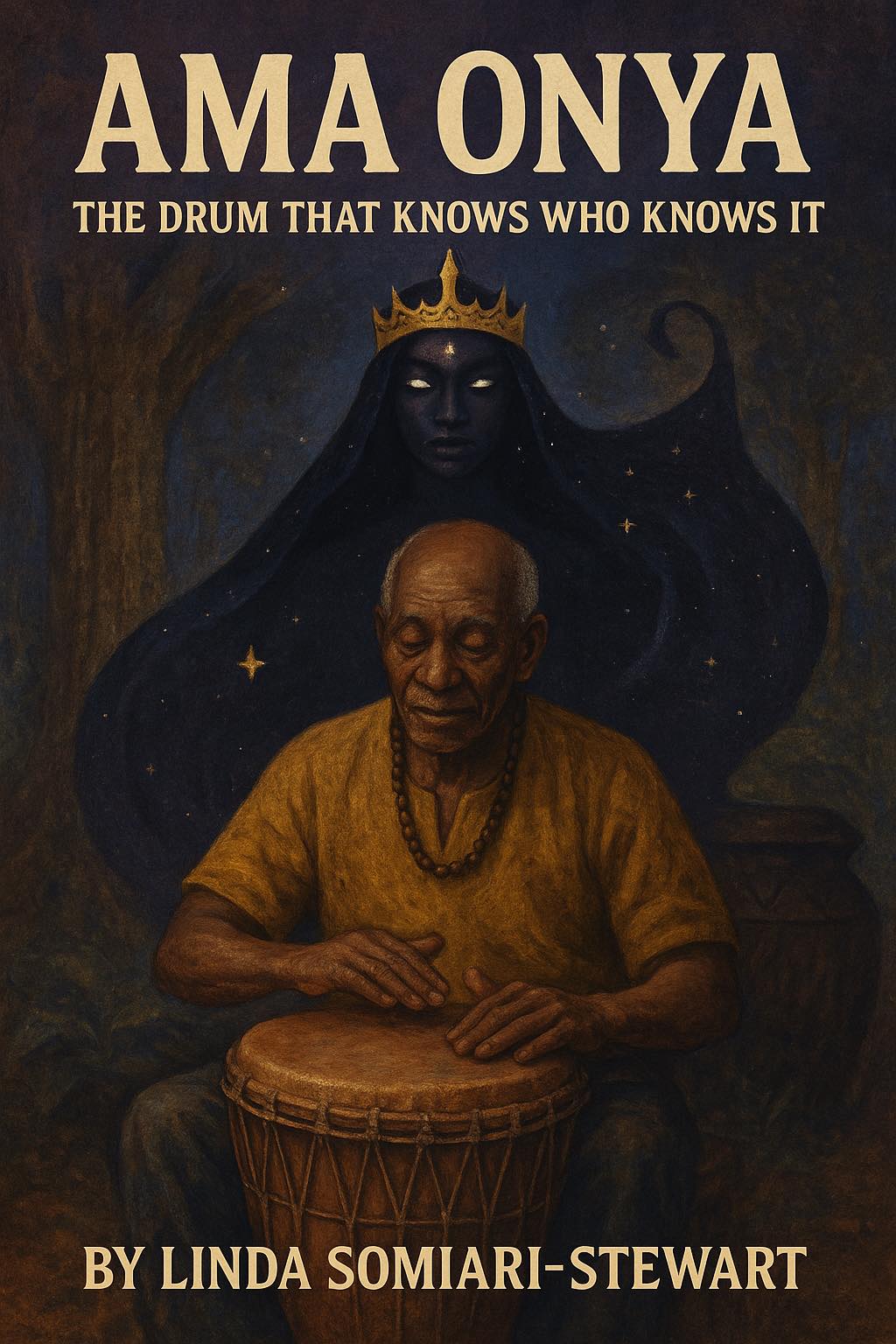
Ama Onya, Spirit of the Forest Drum by Linda Somiari- Stewart
Ama Onya, Spirit of the Forest Drum

Long time ago- long before radios crackled or cars coughed smoke, before cocoa sweetened the lips of foreign kings-there was a village called Ngwasi, nestled at the foot of three talking hills.
There, every moon cycle, the people gathered for Egwu Onya - the Festival of Finest Beats. It was no mere contest, but a sacred rite. Drummers summoned stories, spirits, and seasons through rhythm.
In Ngwasi lived Baba Akarika, a man whose back curved like a bowed string, whose voice crackled like dry leaves - but whose hands, ah, his hands could still speak in drums. And they did.
Elders told tales of Akarika’s glory days.
When he tapped the skin of his drum, fish danced in the rivers.
When he rolled his palms across the surface, crying babies fell silent.
And when he struck his signature “one-stroke-and-pause,” even thunder tilted its ear.
But times were changing.
Youth now played faster, louder, flashier.
They spun their drums, flipped sticks, made rhythm into spectacle.
Baba Akarika?
He simply sat on his wooden stool like a stone in the riverbed, watching.
His grandson, Sefu, was the noisiest of the new breed.
Fast-fingered. Flashy. Proud.
He wore carved beads, oiled his skin, and performed boldly at every ceremony.
“Grandfather,” Sefu said one evening, tapping his fingers idly, “you’re not entering the festival this year, are you?”
Akarika looked up from his old drum. It was a wide, dark djembe, its rim bearing the teeth marks of time.
“I might,” he said softly.
Sefu laughed, drumming sharply.
“The people want fire now, not smoke. Leave the stool for the young lions.”
Akarika only nodded and went back to rubbing shea butter into his drum until it glowed like evening sun on water.
Then came Festival Day, wrapped in chants and cloth, in feathers and drums.
From far and wide, the people gathered.
Each drummer had to awaken the Forest Drum, a sacred relic said to echo only for the worthy. If it answered, they could compete. If not, they were dismissed in silence.
Sefu stepped forward, beaming.
His hands flew. His feet danced. His drum roared like a harmattan stampede. But the Forest Drum?
Silent. Not a whisper.
Others came, all young and bold.
They all failed.
Then, just as mocking murmurs rose from the crowd, Baba Akarika stepped forward.
No airs. No strut.
Just a quiet presence.
He didn’t raise his drum.
He didn’t bow.
He simply knelt and whispered:
“Old age has nothing on an old man when it is time for beating the drum he knows how to beat.”
Then he began.
Not fast, not loud, just steady and true, ancient, original.
He played Aja-Ndoto, a rhythm that called lost ancestors.
Then Eke-Nwa, a beat reserved for the naming of twins.
Then silence. His hand rested gently on the drum.
And the Forest Drum…
BOOM!
Then again.
BOOM!!
And once more.
BOOM!!!
Three times it answered in perfect rhythm for perfect memory.
The crowd froze, the baobab shivered.
Even the wind changed direction!
Out of the air shimmered Ama Onya, Spirit of the Forest Drum. She appeared as a crowned woman with skin like shadow and eyes like stars. Her voice gurgled softly, like water over smooth stones.
“This one remembers,” she said.
“While others perform. He does not beat the drum, he speaks it.”
She turned to Sefu.
“You may have speed,” she said,
“But you do not yet know the story of the drum.
You cannot lead until you have listened.”
Sefu bowed, not in shame, but in newfound understanding.
That day, Baba Akarika was crowned Elder of Echoes, Keeper of Sacred Rhythms.
And from that day on, Sefu sat beside him, not to compete, but to learn.
⸻
Thoughts

• Respect age not for its years, but for what it has practiced into mastery.
• The loudest does not always lead; sometimes the deepest rhythm is the softest one.
• Modern speed must learn from ancient knowledge. Before you beat your drum, know its name.
Never forget: the road was first walked by the old.
Ask questions. Listen deeply. Learn rhythm before noise.