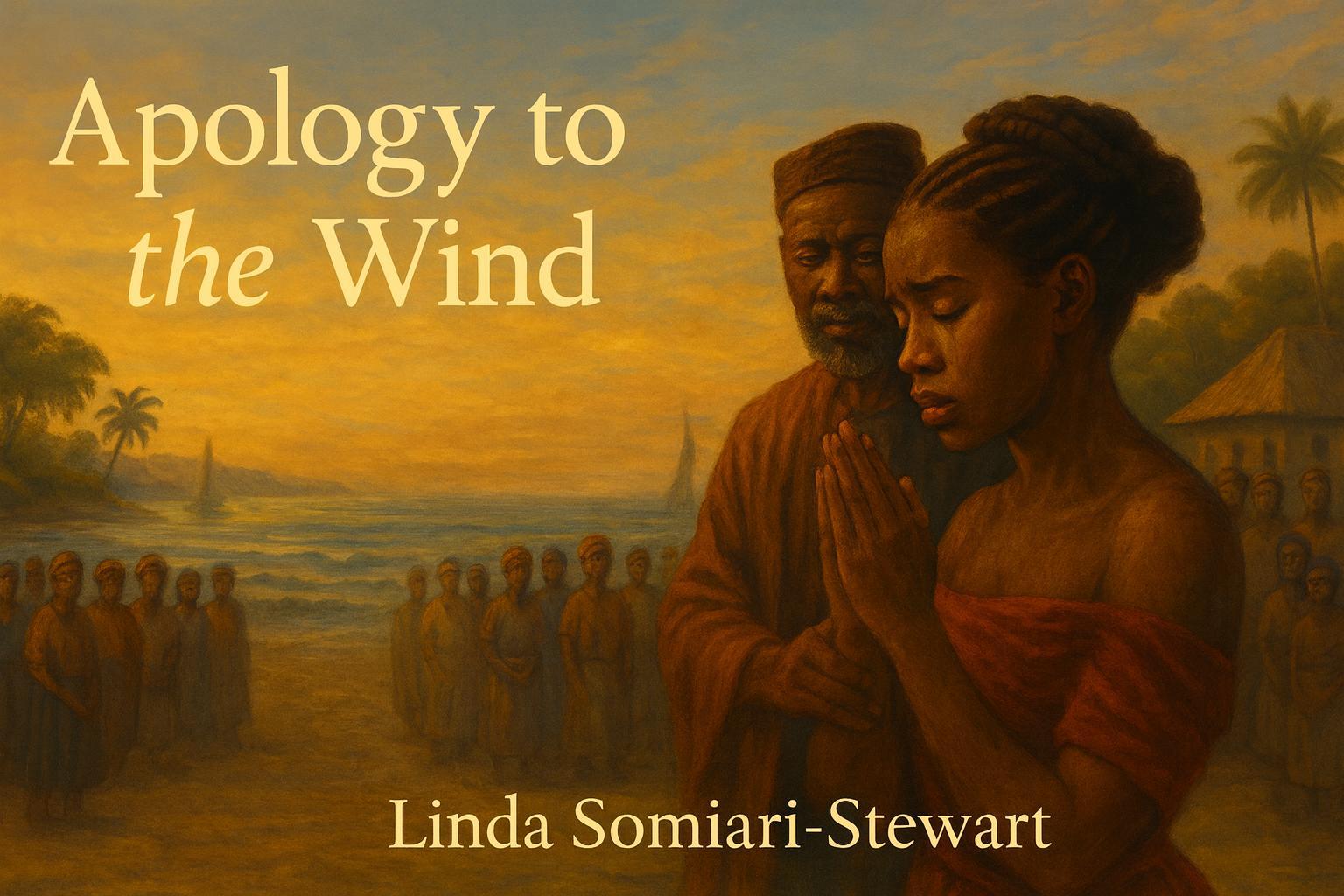
Apology To The Wind by Linda Somiari-Stewart
A forgotten curse, a whispered apology, and the sea that never forgets. Her beauty was her gift, her pride her downfall, and only the wind could carry her apology to the right doorstep.
Bound by a lover’s curse, Agake-ere must surrender her pride or remain chained forever.
In Bou-Pere, the sea forgets nothing, and only truth spoken to the wind can heal the past.
Apology To The Wind
by
Linda Somiari-Stewart.
Long ago, when the tides of the oceans still spoke to men, there was a village called Bou-Pere. It stood on the edge of the great waters, where the mangroves stretched their arms into the sea, and the fishermen said the waves carried the voices of the ancestors. Life in Bou-Pere moved with the rhythm of the tide—nets were cast at the flow tide, fires smoked fish by noon, and drums spoke to the moon and the villagers by night. The people lived by the sea, but they also feared it, for the sea, they said, “forgets nothing and always returns what is hidden.”
Among the people of Bou-Pere was a maiden named Agake-ere. From her birth, the elders whispered that she carried the essence of the river goddess upon her face. She grew tall and graceful, and her beauty shimmered like moonlight dancing on water. So radiant was she that the old women said even the river held its breath when she passed. But beauty is a double-edged paddle: it can steer a canoe to shore or capsize it.
In her youth, Agake-ere treated love as a joke, a game. There was a constant trickle of suitors into her father’s compound, each hoping to claim her hand, but she laughed lightly, promised carelessly, and cast them aside when their devotion grew too heavy. She wore pride like coral beads around her neck. She was dazzling, but hard. Among those she wounded were men sincere and true in the love they professed. She mocked their tears when they cried before her, and for most of them, grief lingered in their hearts.
Now Agake-ere was of marriageable age, and the tide had turned against her. Suitors no longer came. Those who did seemed uneasy, as if a shadow pushed them away. Her beauty was still praised, but it no longer drew love; it drew whispers.
Her father, Chief Igodo, grew troubled. By the fireside one night, he said:
“My daughter, the moon has ripened, yet your canoe drifts empty. Men come to your shore and depart. A jewel unclaimed gathers dust, and the father of such a jewel carries shame.”
Agake-ere lowered her eyes but gave no answer. In the stillness of her heart, anxiety grew. She remembered Oweizide, Asara, Pere, Nana, and others; she often saw sorrowful and angry male faces in her dreams, but didn't make much of such dreams.
One morning, Chief Igodo went to seek counsel. He walked to the mangrove edge where Ala-fun, the wise man, lived. Ala-fun’s beard was tangled like the roots of the swamp, and his eyes were as patient as the tides.
“Father of wisdom,” Igodo said, bowing low, “my daughter is as radiant as the moon, yet no man will stay with her long enough to conclude the wooing stage. They flee as if chased by spirits. What binds her luck?”
Chief Igodo sighed deeply. “But she does not know whose heart she wronged most. How can she ask forgiveness when the face is hidden?”
In the middle of the square, Agake-ere stood trembling, her father’s hand firm on her shoulder. The sun rose over Bou-Pere, and the sea’s breath moved through the palms, whistling secrets.
The villagers felt the air change as her words rose like smoke and drifted with the wind toward the waters. Some shook their heads in pity; others scorned. Her father took her hands and led her home.
That day, Agake-ere would not eat, nor would she listen to her mother’s consoling words.
In his dream, he stood on the edge of the sea. The waves rose high, calling his name. Across the waters, Agake-ere appeared, clothed in white but covered in sackcloth from her head to her shoulders, her head bowed low. She fell to her knees, her voice trembling:
“Nana, forgive me. I mocked what I did not understand. I trampled on the love you gave. Please forgive me and release me from the chains of my past.”
After she spoke, the waves fell still. The moonlight spread like a golden road across the water. The sackcloth around her head ripped and slipped away.
“Ayiba nua.”But Agake-ere’s journey to healing did not end that morning after she woke from sleep. She spent moons quietly, walking humbly among her people, serving at her mother’s side, listening where once she mocked, speaking gently where once she scorned. The villagers saw the change and began to say: “The ancestors have humbled her.”
One season, a young man came to Bou-Pere with his parents. His canoe was small, his dressing modest, but his heart was steady. Unlike before, Agake-ere did not greet him with careless laughter. She listened. She answered with humility. And for the first time, love did not slip away.
MoralThe Ijaw say: “The sea forgets no wrong, but it returns peace when truth is spoken.”
A careless heart ties knots in its own spirit and covers itself in sackcloth. Only a sincere apology, cast like a net into the wind, can untangle the past and make way for tomorrow’s sweetness.